Resources
Art of: Growth
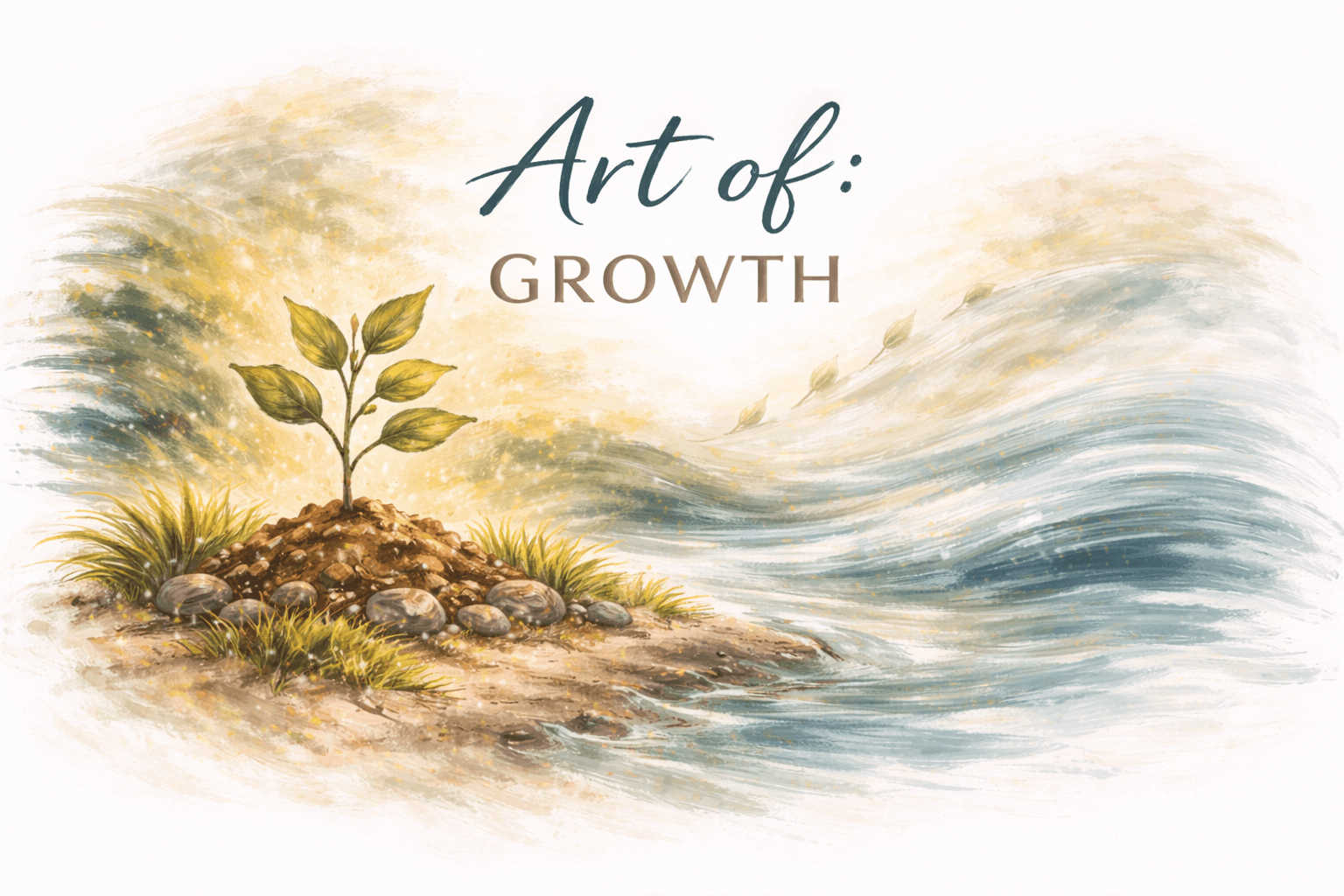
What This Series Is
Art of: is a reflective space for learning and practice. Each post explores a human experience as an art and something developed through curiosity, patience, and relationship to self and others. These reflections are offered as invitations. You are welcome to take what’s useful and leave the rest. Each piece explores a foundational element of psychological and emotional health : safety, acceptance, regulation, action, embodiment. With and additional focus on how they build upon one another. Art of: is all about integration. Because healing is something you learn to practice.
Welcome to the Art of: Growth! and this is where the series begins!
A Reflection on Growth
Growth is often mistaken for acceleration. We imagine it as forward motion, visible progress, measurable change. Do more. Heal faster. Be better. Move on. In a culture that prizes productivity and performance, growth is easily confused with achievement.
True growth is rarely loud. It does not rush. It does not force. True growth is the decision to remain present long enough to notice the pattern instead of escaping it. It is choosing curiosity over reactivity. It is allowing discomfort without immediately trying to eliminate it. Growth is not about becoming someone else; it is about becoming more fully yourself. True growth begins with honesty. Not the performative kind, but the quiet internal truth-telling that says: I am tired. I am afraid. I keep repeating this. This matters more than I’ve allowed it to. That honesty becomes the soil from which everything else grows. Without it, change may happen, but it rarely lasts.
We often attempt to grow at the surface level. We try to eliminate symptoms, optimize habits, refine routines. Surface work asks, “How do I stop feeling this?” Root work asks, “What is this feeling protecting?” Surface work seeks control. Root work seeks understanding. Sustainable growth requires root work. Our patterns did not appear randomly. They formed in response to experience. The nervous system adapted in order to survive, belong, succeed, or endure. What once kept you safe may now keep you stuck. Growth is not about shaming those adaptations. It is about understanding them well enough to gently update them. This is why growth cannot happen in survival mode. When the body is braced for threat, even positive change feels destabilizing. The nervous system resists what it does not perceive as safe. That resistance is not weakness; it is protection. Before growth can deepen, safety must widen. Not perfect safety, but enough steadiness that the body can soften. In that softening, new choices become available.
Growth, then, is less about dramatic transformation and more about subtle shifts. It is the pause before responding. The willingness to set a boundary. The ability to stay present during discomfort. These moments may appear small, but they change trajectories. A life is shaped by accumulated responses, not single breakthroughs. There is also a misconception that growth is linear. It is not. It spirals. The same themes resurface at deeper layers. Lessons return, not because you failed, but because you are ready to encounter them with greater capacity. What once overwhelmed you may now be tolerable. What once defined you may now be understood as only one part of you.
Growth requires devotion. Not intensity. Not constant effort. Devotion. Devotion to what is true. Devotion to what matters. Devotion to returning , again and again, to alignment. Some days that devotion looks like insight. Other days it looks like rest. Sometimes it looks like grief. Sometimes it looks like courage. All of it counts.
When growth is grounded, it does not make you more impressive. It makes you more real. More integrated. More embodied. You begin to respond instead of react. You hold complexity without collapsing into certainty. You no longer need to perform safety; you begin to feel it. This is the foundation of the work. Before safety, before acceptance, before regulation, before action and certainly before embodiment, there is a simple turning toward yourself. Growth begins in that turning. Not to fix. Not to force. But to understand.
Growth is not an achievement. It is a practice. And like any art, it is cultivated slowly, with patience and care.
This reflection was written by,
Roger Lee Crowe III, LCSW Owner/ Psychotherapist Art of Growth Counseling Services, PLLC.
Art of: Growth
This reflection is part of the Art of: series,
You don’t need to read these in order.
You don’t need to agree with everything.
You don’t need to be ready.
Growth starts wherever you already are.
This series is here to support you at your pace, in your own way.
It's Your Time