Articles
Lessons From Wabi Sabi: Letting Imperfection Be Enough
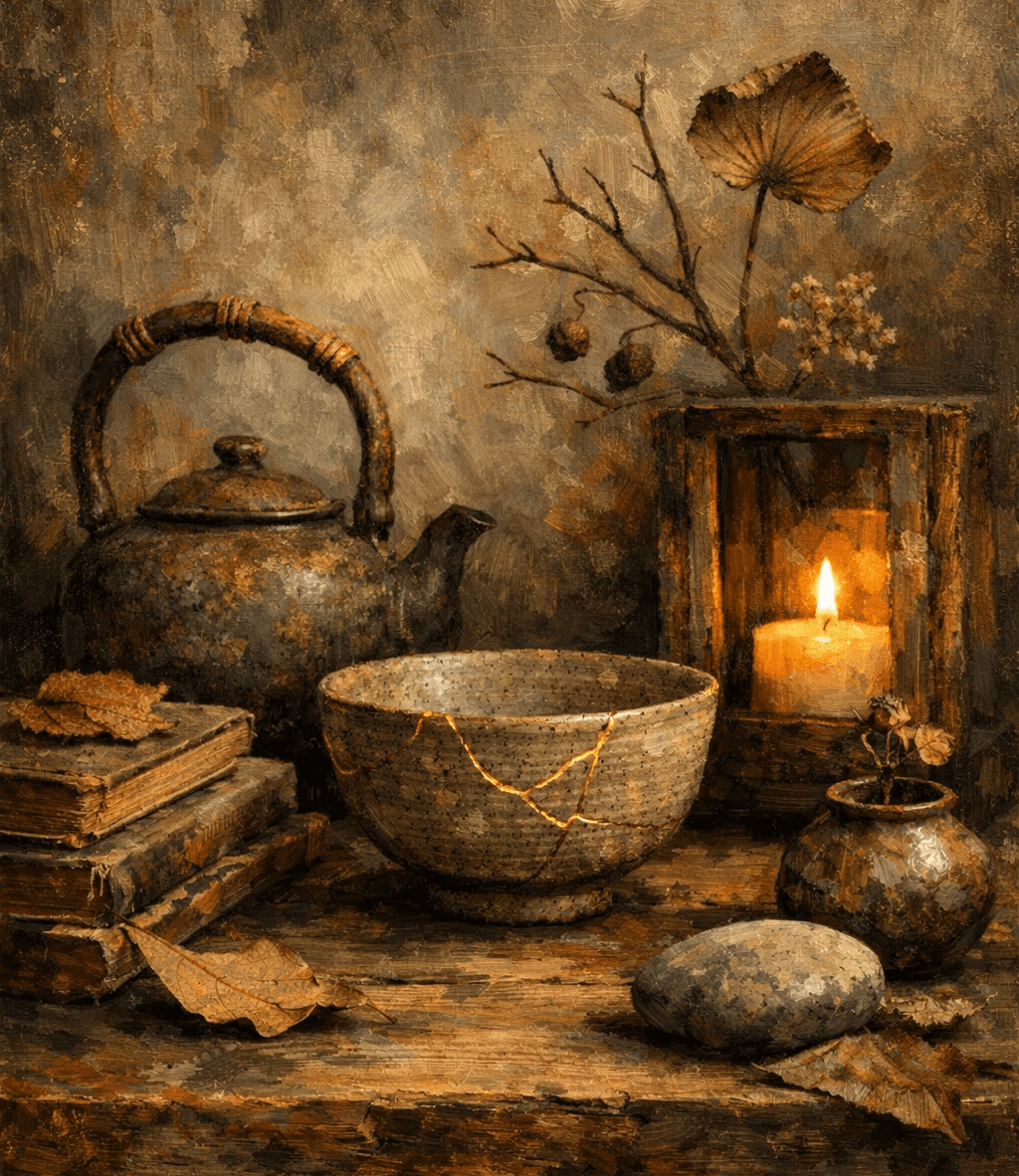
We are often taught to value what is polished, complete, and unblemished. We learn to admire what appears whole, efficient, youthful, and put together. Much of life is spent trying to fix what feels unfinished in us, hide what feels cracked, and outrun what reminds us that we are changing. But there is another way of seeing.
Wabi Sabi is the art of finding beauty not in perfection, but in reality. It is the recognition that life is incomplete, impermanent, and marked by wear. It does not ask us to pretend loss is lovely or pain is easy. It simply invites us to stop measuring beauty by flawlessness. A weathered table, a chipped bowl, fading light at the end of day, a face shaped by grief and laughter alike, all carry a kind of beauty that cannot exist without time.
Wabi Sabi is the quiet acceptance that to life is imperfect and continually changing. Everything meaningful is touched by time. Wood warps. Metal rusts. bodies age. relationships shift. dreams change shape. Even the self you once worked so hard to become will not remain exactly as it was. Life does not preserve. It transforms.
This can be difficult for us because much of human suffering is intensified by resistance to what is already true. We do not only grieve pain itself. We grieve that things did not stay the way we wanted. We feel shame not only because we are wounded, but because we believe we should have emerged untouched. We judge ourselves for our scars, our tiredness, our limitations, our complexity. We want to be clean where life has made us textured.
But healing is rarely pristine. It is often uneven, slow, and full of contradiction. There are days of clarity and days of collapse. There are parts of you that have grown strong and other parts that still feel tender, frightened, or unfinished. Wabi sabi makes room for this. It reminds us that wholeness does not require smoothness. Something can be worn and still worthy. It can be fractured and still beautiful. It can be incomplete and still enough.
There is a humility in this way of seeing. Wabi sabi softens the demand to conquer life. It helps us live with more reverence for ordinary things, the imperfect conversation, the quiet home, the handmade object, the imperfect body carrying a faithful soul. It draws us back to the sacredness of what is simple and real. Not the image of life, but life itself.
To live with wabi sabi is to loosen your grip on impossible standards. It is to stop asking whether everything is flawless and begin asking whether it is true. It is to notice that the most meaningful parts of life are often the least polished. The places where love endured. The places where grief left its mark. The places where you had to rebuild. The places where your humanity became visible.
And perhaps this is part of wisdom: to become less afraid of the marks life leaves behind. To understand that maturity is not the preservation of innocence, but the integration of experience. To realize that beauty deepens when it is touched by honesty. To know that there is something profoundly human about being shaped by time and still choosing to remain open.
Wabi sabi teaches that peace is not found in becoming untouchable. It is found in learning to cherish what is fragile, fleeting, and real. It is found in letting imperfection be part of the meaning rather than evidence of failure. It is found in seeing that the cracks are not always what diminish a thing. Sometimes they are what let its story be seen.
This reflection was written by,
Roger Lee Crowe III, LCSW
Owner / Psychotherapist
Art of Growth Counseling Services, PLLC

