Articles
Lessons From Bonsai: Growth Through Pruning
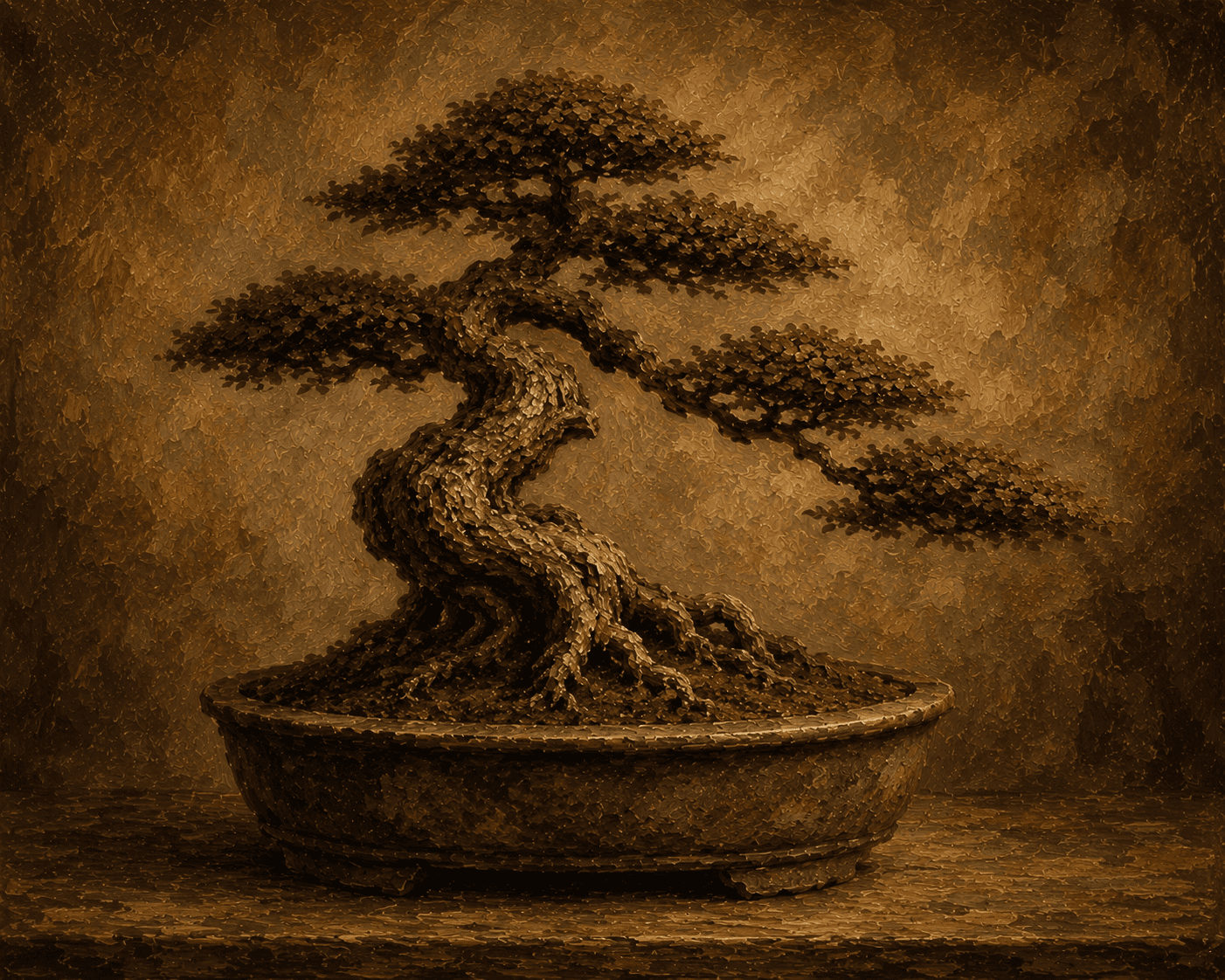
We usually think growth means becoming larger, faster, more expansive. We associate health with unrestricted flourishing, roots spreading freely, branches reaching endlessly outward. Much of modern life teaches us that success is measured by accumulation: more achievement, more productivity, more visibility, more control. To be small is often mistaken for limitation. To be slow is mistaken for failure. But bonsai offers another way of understanding growth.
A bonsai tree is not simply a miniature tree. It is a living relationship between growth and restraint, wildness and intention, freedom and form. Through careful pruning, shaping, patience, and time, the tree is guided into becoming something both disciplined and deeply alive. Its beauty does not emerge despite limitation, but partly because of it.
This can seem strange at first. Why would anyone intentionally prune healthy branches? Why limit growth that naturally wants to expand? Yet bonsai teaches something profound about the human condition: not all growth comes from endless expansion. Sometimes growth requires containment. Sometimes wisdom is found not in becoming more, but in becoming more intentional with what remains.
Human beings often live as though every impulse must be followed, every opportunity pursued, every desire fulfilled. We fear boundaries because they can feel like deprivation. We resist limits because they remind us we are finite. Yet without pruning, life easily becomes overgrown. Our attention fragments. Our relationships thin out. Our nervous systems remain constantly stretched toward what is next. We accumulate obligations, identities, distractions, and ambitions until we no longer know what is essential.
Bonsai reveals that pruning is not always destruction. Sometimes it is devotion.
To shape a bonsai requires patience measured not in days, but in years. Growth cannot be forced. The tree responds slowly. Some branches must be cut so others may deepen. Some roots must be restrained so the whole organism can remain balanced. Every adjustment affects the entire living system. The process is careful, relational, and ongoing.
Human development often works the same way. Maturity is rarely the result of unchecked expansion. It often emerges through discernment, learning what to nurture and what to release. There are habits that must be pruned. Defenses that once protected us but now constrict us. Ways of living that consume energy without producing meaning. Healing sometimes requires cutting away what no longer allows life to flow freely.
This is difficult because pruning can feel like loss. We grieve the identities we cannot sustain. The futures that will not unfold exactly as imagined. The versions of ourselves built around survival, achievement, pleasing others, or endless striving. Letting go can feel unnatural, even frightening. Yet bonsai reminds us that careful limitation is not always diminishment. It can be an act of refinement.
There is also humility in bonsai. No matter how carefully shaped, the tree is never fully controlled. It still bends toward light. Seasons still affect it. Leaves still fall. Storms still leave marks. The artist works with the living nature of the tree, not against it. Bonsai is not domination over nature, but collaboration with it.
This too holds wisdom for human life. We suffer when we try to force ourselves into rigid perfection or demand absolute control over our becoming. Healing is not mechanical. Growth cannot be entirely engineered. We are living systems shaped by biology, memory, grief, attachment, hope, and time. We do not become whole through force. We become whole through relationship, patience, and ongoing care.
A bonsai tree often appears ancient despite its size. Its twisted trunk, exposed roots, and weathered bark carry the feeling of endurance. It reflects the quiet dignity of something shaped slowly over time. In this way, bonsai challenges the assumption that power must appear large or loud. There is strength in rootedness. There is wisdom in restraint. There is beauty in a life shaped carefully rather than consumed endlessly.
Perhaps this is part of maturity: learning that a meaningful life is not measured by how much we accumulate, but by how deeply we cultivate what matters. To become more present rather than merely more productive. More grounded rather than merely more impressive. More aligned rather than endlessly expanded.
Bonsai teaches us that growth and limitation are not always opposites. Sometimes the very boundaries we resist are what allow depth, balance, and beauty to emerge. Sometimes pruning creates space for life to breathe again. Sometimes the shaping itself becomes part of the art.
And perhaps peace comes when we stop asking life to make us limitless and begin learning how to become rooted, intentional, and fully alive within the reality of our humanity.
This reflection was written by,
Roger Lee Crowe III, LCSW
Owner / Psychotherapist
Art of Growth Counseling Services, PLLC

